 Demo mode settings

Air Cleaners
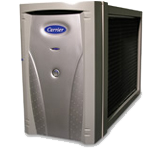

A whole-house air cleaner, also called a whole-house air purifier, is a filtration system installed in your HVAC ductwork that cleans the air throughout your entire home, not just the space near your furnace. It does more than catch visible dust. This kind of indoor air quality (IAQ) system removes tiny allergens, helps neutralize airborne germs, and keeps the air in your home fresh in every room.
Signs Your Home Could Use an Air Cleaner
Not sure whether a whole-house air cleaner is worth it? If a few of these sound familiar, you may benefit from an air cleaner.
An air cleaner only reaches its rated performance when it is matched to your system and installed correctly in your ductwork. Carrier Test Dealer - DS handles the fit and setup so airflow stays strong and your heating and cooling equipment stays protected. Learn more about our indoor air quality specialists.
MERV Ratings and Airflow
When you shop for a whole-house air cleaner, you will run into a few industry ratings that describe how well a filter traps particles and how much it slows down your airflow. Knowing these terms helps you pick a filter that cleans the air well without overworking your system's blower.
What MERV Ratings Mean
MERV (Minimum Efficiency Reporting Value) is the national scale that measures how well a filter captures particles between 0.3 and 10 microns in size. The higher the MERV number, the smaller the particles the filter can trap.
For most homes, MERV 11 to 13 is the most common range, giving strong filtration without straining a standard system.
MERV 16 is the practical ceiling for residential filtration. True HEPA filtration, the standard used in hospitals, surgical suites, and clean rooms, captures even smaller particles, but it needs a dedicated bypass system rather than a standard filter slot.
Balancing Filtration and Airflow
A common worry when moving to a higher-efficiency filter is air resistance, which the industry calls static pressure. A thin 1-inch filter with a high MERV rating can act like a brick wall in your ductwork, choking off airflow and making your system freeze up or overheat.
Whole-house air cleaners solve this with deep, pleated filter media, usually 4 to 5 inches thick. All that extra folded surface area gives the air far more room to pass through, so the air cleaner can hit a high MERV rating (11 to 16) while airflow stays strong and smooth across your equipment.
Comparing Air Cleaner Technologies
MERV ratings describe filter media, but that is only one type of whole-house air cleaner. Most homes choose from four approaches, and many combine them. Here is how they compare.
| Technology | How It Works | Best At Removing | Upkeep | Best For |
|---|---|---|---|---|
| Media Filter | Air passes through thick, folded filter media that traps particles as they go by. | Dust, pollen, pet dander, and mold spores (rated by MERV). | Replace the filter every 6 to 12 months. | Most homes wanting strong, all-around filtering. |
| Electronic Air Cleaner | Gives particles an electrical charge so they cling to a collector cell or charged pad. | Very fine particles, smoke, and some odors. | Wash the collector cells or swap the pad on a regular schedule. | Homes dealing with smoke or fine-dust concerns. |
| Germicidal UV Light | Shines UV-C light on the coil and passing air to disrupt living organisms. | Mold, bacteria, and viruses (it does not trap dust). | Replace the UV bulb about once a year. | Adding germ control alongside a filter, not instead of one. |
| Ionization & Oxidation | Adds charged ions or oxidizers to the airstream that clump particles together and break down odors and germs. | Odors, airborne chemicals (VOCs), and germs, and it helps filters catch finer dust. | Replace the ionizer needles or catalyst cell on the manufacturer's schedule. | Layering extra odor and germ control onto a filter. |
Germicidal UV works best paired with a good filter rather than on its own. Learn more on our UV air treatment page.
Our Air Cleaning Products
Want to compare specific systems? Here are the air quality products Carrier Test Dealer - DS installs and services:
Professional Sizing, Installation, and Maintenance
The right installation and a little upkeep keep your air cleaner filtering well without slowing your system down. A smart thermostat can also remind you when the filter is due.
To keep your air cleaner and whole HVAC system functioning properly and efficiently without interruptions, contact Carrier Test Dealer - DS in Libertyville, IL to schedule regular maintenance today.
Schedule Maintenance Service Today
Sizing
We look at your home, your air quality concerns, and your furnace or air handler to choose the right type and MERV rating.
Mounting
We mount the cabinet in the return duct beside your furnace or air handler, where all of the circulating air passes through it.
Sealing
We seal every joint so no air slips around the filter. Electronic and ionization models are also wired to run with your blower.
Airflow Check
We measure static pressure to confirm your system still moves air freely with the new filter in place.
Startup
We run the system, test everything, and show you how to open the cabinet and change the filter.
Once it is running, upkeep is simple. Replace the media filter every 6 to 12 months, sooner with pets or heavy dust, and follow the schedule for any electronic, UV, or ionization parts.
Frequently Asked Questions About Air Cleaners
Air Purification Product Offering

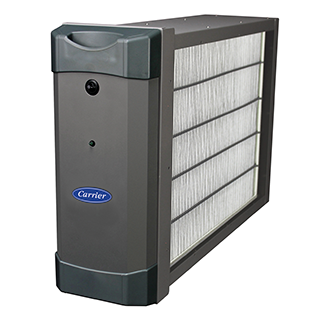
Infinity® Air PurifierView Brochure |
|---|
| Model Family: DGAPA |
| Filter efficiency: Up to 95% /1.0-3.0 micron |
| Germicidal rate: Up to 99% |
| Warranty: 10-Year Parts Limited Warranty |
Manufacturer's Stated Benefits:
|
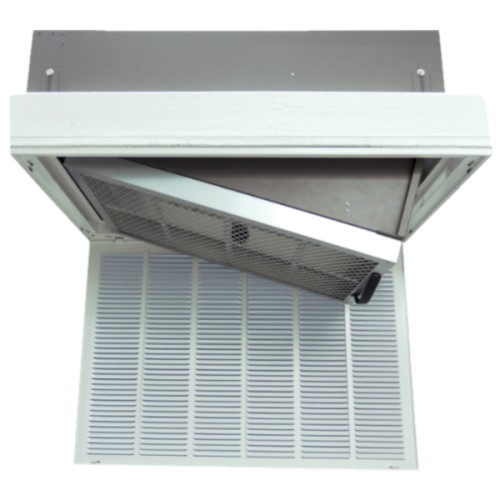
Infinity® Return Air PurifierView Brochure |
|---|
| Model Family: RGAP |
| Filter efficiency: Up to 95% /1.0-3.0 micron |
| Germicidal rate: Inactivates 99% of select airborne germs and viruses |
| Warranty: 10-year parts limited warranty upon timely registration. |
Manufacturer's Stated Benefits:
|

Comfort™EZ Flex Cabinet Air Filter - Merv 13View Brochure |
|---|
| Model Family: EZXCAB-13 |
| Filter efficiency: Up to 65% / 1.0-3.0 micron |
| Germicidal rate: Not Applicable |
| Warranty: 10-Year Limited Warranty on Filter Housing |
Manufacturer's Stated Benefits:
|
Comfort™EZ Flex Cabinet Air Filter - Merv 10View Brochure |
|---|
| Model Family: EZXCAB-10 |
| Filter efficiency: Up to 65% / 1.0-3.0 micron |
| Germicidal rate: Not Applicable |
| Warranty: 10-Year Limited Warranty on Filter Cabinet |
Manufacturer's Stated Benefits:
|